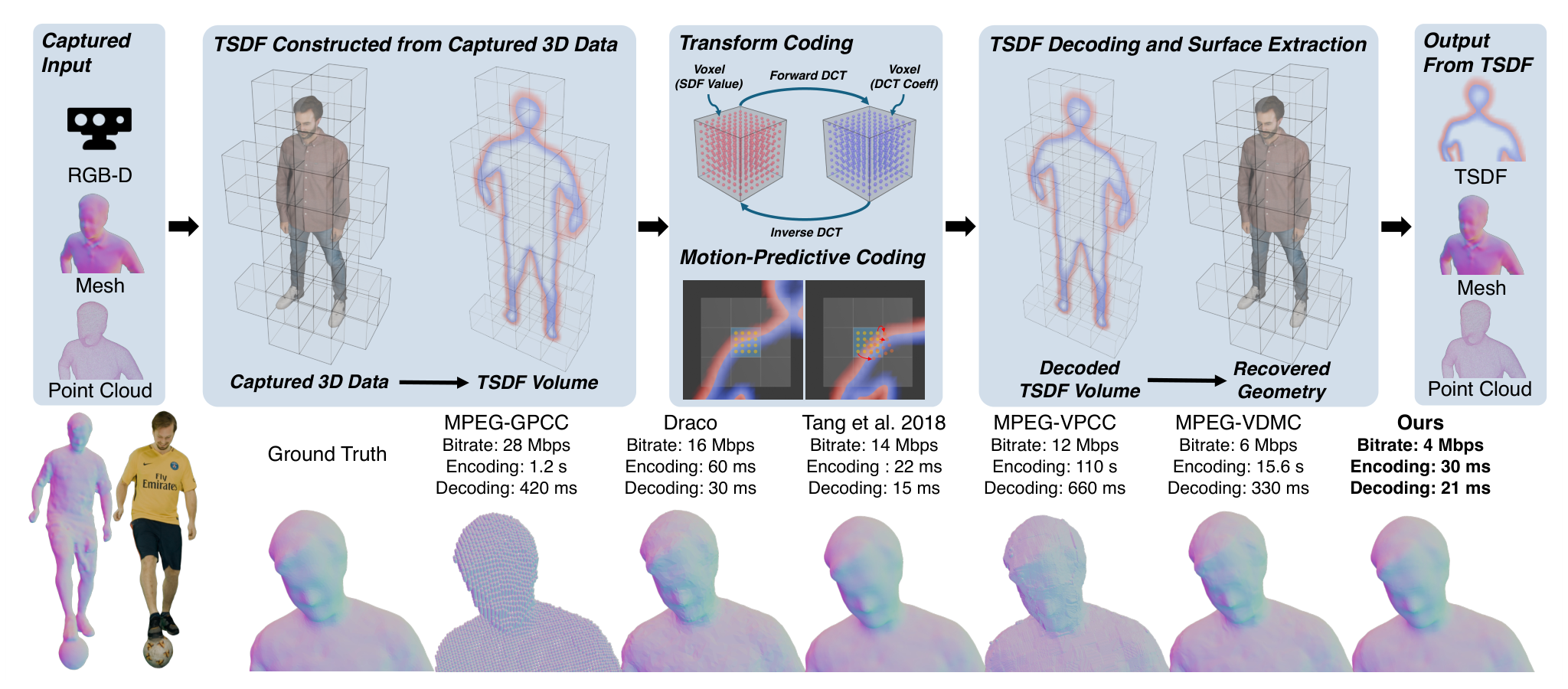
The rapid adoption of volumetric capture technologies has created a pressing need for efficient storage and streaming of dynamic 3D content. Unfortunately, current compression standards often treat dynamic sequences as independent frames or rely on computationally expensive non-rigid registration, making them unsuitable for real-time applications or large-scale environments. In this paper, we present a novel end-to-end compression framework for dynamic Truncated Signed Distance Field volumes derived from captured 3D content, leveraging a representation that is temporally stable, easily parallelizable, and already widely used in scene reconstruction and volumetric fusion pipelines. We then adapt classic 2D video coding paradigms such as spatial coding via Discrete Cosine Transform and temporal coding using a real-time motion compensation pipeline to provide robust, real-time, and training-free encoding and decoding for 3D content. Extensive evaluations on human performance captures demonstrate that our codec achieves ~35% bitrate savings at equal distortion while operating in real time at 30 FPS, while stronger temporal coherence in large-scale synthetic environments yields up to 12× bitrate reduction at equal distortion.
@article{jin2026implicit,
  title={Implicit Surface Compression—with Good Old Discrete Cosine Transform and Motion Compensation},
  author={Jin, Tao and Wu, Shengxi and Huang, Tianshu and Dasari, Mallesham and Seshan, Srinivasan and Rowe, Anthony},
  journal={ACM Transactions on Graphics (TOG)},
  volume={45},
  number={4},
  pages={1--14},
  year={2026},
  publisher={ACM New York, NY, USA}
}This work was supported by Bosch Corporate Research and in part by the National Science Foundation under Award IIS-2544317. We thank the anonymous reviewers for their constructive feedback. We are also grateful to Ioannis Gkioulekas for an insightful discussion, Yoshiki Takashima for suggesting the use of the Blender Film sequences to demonstrate the scalability of our codec, and Ankush Jain for saving the day with last-minute help in generating the .bbl file before the submission deadline.
This project page is built on the Nerfies template by Keunhong Park et al. Many thanks to the authors for releasing their source code.